
Roof vents for metal roof installations are one of the most important yet under-discussed components of a complete metal roofing system, because a metal roof without proper attic ventilation traps heat, allows moisture and condensation to build up on the underside of the roof deck, shortens the life of insulation, and can eventually cause structural damage from rot even though the metal itself is doing everything it should. Ohio’s climate makes ventilation particularly important: hot humid summers push interior moisture up into the attic where it can condense on cool metal panels, and cold winters combined with occasional warm interior air can cause ice dams if attic ventilation is inadequate. The good news is that metal roofs work with several proven ventilation strategies, and homeowners in Kettering and surrounding areas have four solid options to choose from depending on the roof design, house geometry, and budget. Understanding all four options helps homeowners specify a metal roofing system that performs well for decades in Ohio’s demanding four-season climate.
- Why ventilation matters: Even the best metal roof needs proper attic ventilation to prevent condensation and heat buildup.
- What Ohio homes need: A balanced intake-and-exhaust system suited to freeze-thaw and humid summer conditions.
- What you will learn: 4 key vent options for metal roofs plus how to choose the right one for your home.
Why Metal Roofs Need Special Attention to Ventilation
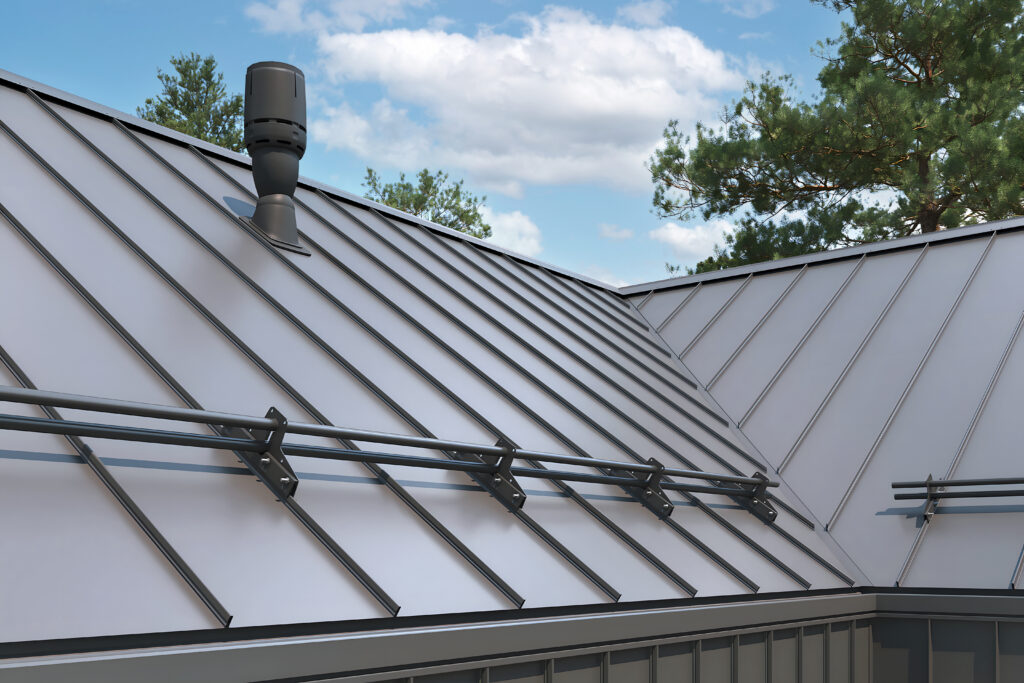
Why metal roofs need special attention to ventilation comes down to how metal panels transfer heat and moisture differently than asphalt shingles, and how the flashing details at any roof penetration matter more on metal than on other roof types. Understanding these dynamics is the foundation for choosing the right vent strategy.
How Attic Ventilation Actually Works
Attic ventilation actually works through a balanced system of intake vents at the low end of the roof and exhaust vents at the high end, using natural convection (hot air rises) to move air through the attic space. According to the U.S. Department of Energy’s Building America Solution Center, vents are installed at the soffits and at or near the ridge, with baffles at each soffit vent to provide a pathway for ventilation air from the soffit to the ridge, and the lower soffit vents supply air to the attic space while the upper roof or attic vents exhaust air from the attic. DOE also notes that ridge vents are more effective than off-ridge vents like mushroom or button vents, and that gable-end vents should generally not be used in conjunction with a ridge or off-ridge vents because gable vents can “short-circuit” the attic airflow. This last point is critical for homeowners planning a metal roof installation: mixing vent strategies can actually make ventilation worse rather than better.
- Intake at soffits: Low end of the roof for air supply.
- Exhaust at or near ridge: High end for hot air release.
- Ridge vents: More effective than off-ridge alternatives.
- Avoid short-circuiting: Don’t mix gable vents with ridge/off-ridge vents.
Why Metal Roofs Amplify Ventilation Problems and Benefits
Metal roofs amplify ventilation problems and benefits because metal transfers heat and cold quickly and doesn’t absorb moisture the way asphalt shingles do. A well-ventilated metal roof stays cooler in summer (metal reflects solar heat), sheds interior moisture efficiently, and lasts substantially longer than a poorly ventilated one. A poorly ventilated metal roof can develop condensation on the underside of the panels, drip water onto insulation, promote rust in exposed fasteners, cause paint or coating failures from persistent moisture exposure, and shorten the effective service life of what should be a 40 to 60+ year roof. In Kettering and surrounding areas, where humid summers and freeze-thaw winters create the most challenging conditions for any roof, ventilation quality often matters more than the specific metal roofing product chosen.
- Fast heat transfer: Amplifies both good and bad ventilation.
- Condensation risk: Moisture on cool metal panels.
- Fastener rust: Persistent moisture attacks exposed fasteners.
- Service life impact: Bad ventilation can cut lifespan by decades.
4 Key Roof Vent Options for Metal Roofs
Four specific vent options are used for metal roof installations, each with distinct advantages and best-use scenarios. Understanding all four helps homeowners choose the right approach for their specific roof design and budget.
1. Continuous Ridge Vents (Metal-Compatible)
Continuous ridge vents designed specifically for metal roofs are the most efficient and aesthetically clean option for metal roof ventilation, running along the entire length of the roof’s peak and paired with a matching metal ridge cap that conceals the vent while allowing airflow. Installation requires a 1 to 2 inch continuous gap between the panel ends at the ridge (through the sheathing and metal), covered by a vent profile made of breathable foam or perforated material that allows air to escape while blocking water, insects, and pests. The metal ridge cap then covers the vent and matches the roof’s color and profile. Metal-compatible ridge vents deliver the highest net free ventilating area (NFVA) per linear foot of any option, provide consistent airflow across the entire attic, blend visually with the roof, and match the 40 to 60 year lifespan of the metal panels themselves. Cost typically runs $6 to $14 per linear foot installed, or $300 to $700 for a typical residential ridge length.
- Design: Continuous vent along entire ridge with matching metal cap.
- Best NFVA: Highest airflow per linear foot of any option.
- Cost: $6 to $14 per linear foot installed.
- Best for: Homes with a long central ridge; standard gable roofs.
2. Static Off-Ridge Box Vents
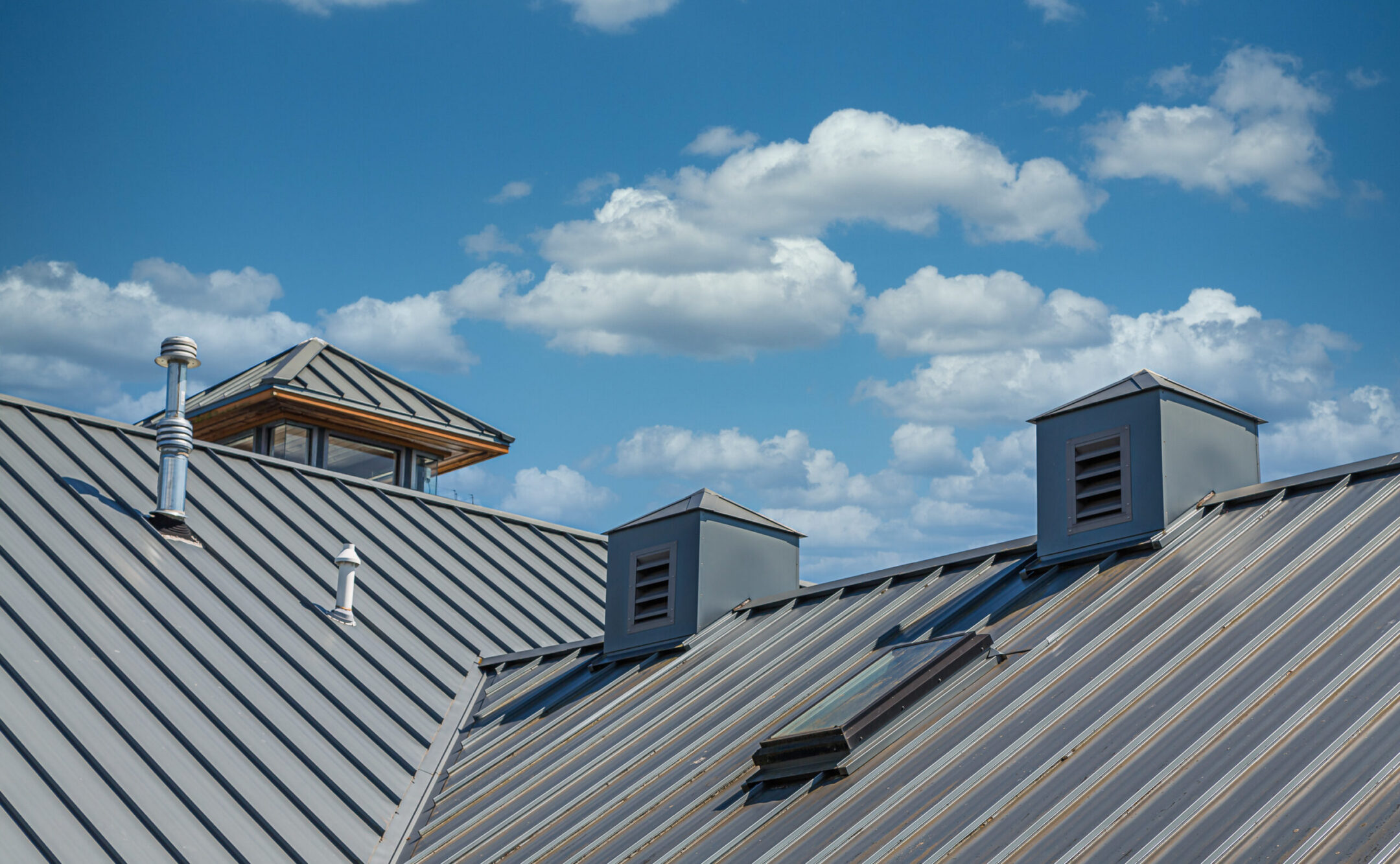
Static off-ridge box vents (also called box vents, low-profile vents, or mushroom vents) are individual roof penetrations placed near the ridge but not on it, providing exhaust ventilation without requiring the continuous ridge modification that ridge vents need. Each box vent has a metal housing with a screened opening that allows air to escape while blocking rain, snow, and insects. Box vents work well for metal roofs where the ridge is short, non-continuous, or interrupted by dormers or hip corners that make ridge vent installation impractical. Multiple box vents are typically needed (one per 300 square feet of attic space as a rule of thumb) to provide adequate airflow. Each box vent installation requires careful flashing where the metal roof panels intersect the vent housing, and any errors create leak points. Cost runs $150 to $400 per vent installed, or $600 to $1,600 for a typical residential setup requiring 3 to 5 vents.
- Design: Individual roof penetrations near the ridge.
- Flashing: Requires careful metal-to-vent transitions.
- Cost: $150 to $400 per vent installed.
- Best for: Roofs with short or interrupted ridges.
3. Turbine Vents (Whirlybirds)
Turbine vents (commonly called whirlybirds) are wind-driven rotating exhaust vents that use the natural motion of wind passing over the roof to actively pull hot air out of the attic. The characteristic spinning metal turbine converts wind energy into an active airflow, delivering exhaust performance that can exceed static box vents in windy conditions but delivers only static airflow (equivalent to a box vent) when there is no wind. Turbine vents work well on metal roofs where wind exposure is consistent (open lots, higher elevations, or homes not surrounded by trees), and their active airflow can be particularly useful in hot summer months when solar heat gain would otherwise overwhelm passive ventilation. Cost runs $200 to $500 per turbine installed. The trade-off is visual: turbines are visible from the ground and don’t have the clean profile of ridge or box vents. Some homeowners consider them dated aesthetically, while others appreciate the traditional look. Modern turbines are quieter than older versions but can still make audible noise in high winds.
- Design: Wind-driven rotating turbine for active exhaust.
- Best in wind: More effective than static vents when wind blows.
- Cost: $200 to $500 per turbine installed.
- Best for: Windy locations; homes prioritizing active airflow.
4. Powered Attic Ventilators (Electric or Solar)
Powered attic ventilators (also called attic fans or PAVs) use an electric or solar-powered fan to actively pull hot air out of the attic, delivering the highest airflow of any option regardless of wind or weather conditions. Electric-powered models plug into the home’s electrical system and typically use a thermostat that turns the fan on when attic temperature exceeds a set point (usually 100 to 110°F). Solar-powered models have a small solar panel that runs the fan whenever there is sunlight, with the airflow naturally matching the periods when the attic is hottest. Powered vents deliver strong performance in Ohio’s hot humid summers when passive ventilation can struggle to keep up with combined heat and moisture loads. Cost varies widely: $200 to $500 for solar-powered units installed, $250 to $600 for electric-powered units installed (electrical wiring not included). The trade-offs are ongoing energy use for electric models, potential to pull conditioned air from the house if the attic isn’t well air-sealed, and mechanical failure risk (fans can wear out and need replacement after 10 to 15 years).
- Design: Electric or solar-powered fan for active exhaust.
- Highest airflow: Regardless of wind conditions.
- Cost: $200 to $600 per unit installed.
- Best for: Hot summers; homes with inadequate passive ventilation.
How to Choose the Right Vent Option for Your Metal Roof
How to choose the right vent option for your metal roof depends on your roof geometry, budget, aesthetic preferences, and the balance between passive and active ventilation you want. A structured approach makes the decision easier.
What Roof Geometry Tells You About the Right Vent Choice
Roof geometry tells you a lot about the right vent choice: homes with long continuous gable ridges are ideal candidates for continuous ridge vents (the best-performing option in most cases), while homes with hip roofs, multiple dormers, or complex intersecting ridges may need to use box vents or a combination. Roofs with limited wind exposure may benefit from powered ventilators to compensate, while windy locations can leverage turbine vents effectively. Very short ridges (less than 20 feet) may not deliver enough ridge vent area to fully ventilate the attic, in which case supplementing with box vents or powered ventilators makes sense. Consult with a roofing contractor who can measure your specific attic area and calculate the required net free ventilating area (NFVA) based on IRC code requirements (typically 1 square foot of NFVA per 300 square feet of attic space when properly split between intake and exhaust).
- Long gable ridges: Ideal for continuous ridge vents.
- Complex roofs: May need box vents or combinations.
- Short ridges: Under 20 feet may need supplemental exhaust.
- NFVA calculation: Match ventilation area to attic size.
What Ohio-Specific Considerations Matter Most
Ohio-specific considerations matter for metal roof ventilation because the state’s climate creates specific challenges. Humid summers (with dew points regularly in the 70s) push interior moisture into the attic where it can condense on cool metal panels overnight. Cold winters combined with insufficient ventilation cause ice dams at eaves when snow melts on warm attic-heated roof surfaces and refreezes at the cold eave edge. Fall and spring transition seasons can produce heavy leaf debris that clogs ventilation systems. Homeowners in Kettering and surrounding areas should specifically ask contractors about how the proposed ventilation system handles Ohio’s summer humidity load, winter ice dam prevention, and any specific challenges from tree cover or roof geometry that might affect airflow. Adequate ventilation combined with proper attic insulation (R-49 to R-60 for Ohio’s climate zone) is the winning combination.
- Summer humidity: Push interior moisture up into attic.
- Winter ice dams: Prevented by adequate ventilation + insulation.
- Debris management: Leaf accumulation affects some vent types.
- Insulation partner: R-49 to R-60 recommended for Ohio.
Frequently Asked Questions
Do Metal Roofs Actually Need Vents?
Yes, metal roofs need vents just like asphalt shingle roofs because the attic space still needs to release heat and moisture regardless of the roofing material. The only exception is unvented conditioned attics where the roof line itself is insulated with spray foam or rigid foam (making the attic part of the conditioned space), but this is a specific building design choice made at construction, not a retrofit option for most existing homes. For a standard vented attic with insulation on the attic floor, ventilation is essential.
Can I Mix Different Types of Vents on the Same Metal Roof?
You should generally not mix different types of exhaust vents (ridge vents plus gable vents, for example) because they can short-circuit the airflow and reduce total ventilation effectiveness. DOE Building America specifically warns against combining gable vents with ridge or off-ridge vents. However, combining intake vents (soffit vents) with a single type of exhaust vent (either ridge OR box vents OR powered ventilators) is the correct approach.
How Much Does It Cost to Add Vents to a Metal Roof?
Cost varies significantly by vent type: continuous ridge vents run $300 to $700 total for a typical residential installation, box vents run $600 to $1,600 for the 3 to 5 vents typically needed, turbine vents run $400 to $1,500 for the multiple units usually required, and powered attic ventilators run $200 to $600 per unit (typically one per home). Retrofit installations on existing metal roofs cost more than integrating vents during new roof installation.
What Happens if My Metal Roof Doesn’t Have Enough Ventilation?
Insufficient ventilation on a metal roof causes multiple problems: condensation on the underside of panels, moisture damage to insulation and roof deck, ice dam formation in winter, higher summer cooling costs, premature failure of paint or protective coatings, potential rusting of exposed fasteners, and mold growth in the attic. These problems often develop slowly and can be difficult to detect until significant damage has occurred, which is why proactive ventilation planning matters.
Do Powered Attic Fans Actually Save Energy in Ohio?
Powered attic fans can save cooling energy in Ohio’s hot summers by reducing attic temperatures and the heat that transfers into the living space below, but the energy math depends on the fan’s power consumption vs. the cooling savings. Solar-powered fans have the best energy math (essentially free operation) while electric fans need careful evaluation. In well-insulated homes with adequate passive ventilation, the additional benefit of powered fans is limited. Poorly insulated older homes or homes with inadequate soffit intake see the biggest benefit.
Will My Insurance Cover Ventilation-Related Roof Damage?
Insurance typically does not cover damage caused by inadequate ventilation because that falls under wear and tear or maintenance issues rather than a covered peril. Damage from specific covered events (wind, hail, fire) is generally covered regardless of whether ventilation was adequate. This is another reason to invest in proper ventilation upfront: fixing ventilation-related damage after the fact often comes out of the homeowner’s pocket entirely.
Why Kettering Homeowners Trust Johnson Restoration for Metal Roof Ventilation
A metal roof is only as good as the ventilation system that keeps the attic below it dry, cool, and free of moisture problems, and choosing the right vent option matters just as much as choosing the right metal roofing product. Johnson Restoration brings over a decade of industry experience to metal roofing projects in Kettering and surrounding areas, with workmanship warranties, financing options, and the expertise to design and install a complete metal roofing system that includes properly sized ridge vents, box vents, or powered ventilators matched to your specific attic and Ohio climate conditions. Whether you are planning a new metal roof installation, upgrading from asphalt shingles, or addressing ventilation problems on an existing metal roof, contact Johnson Restoration today for a free estimate and let our team help you protect your home for decades to come.